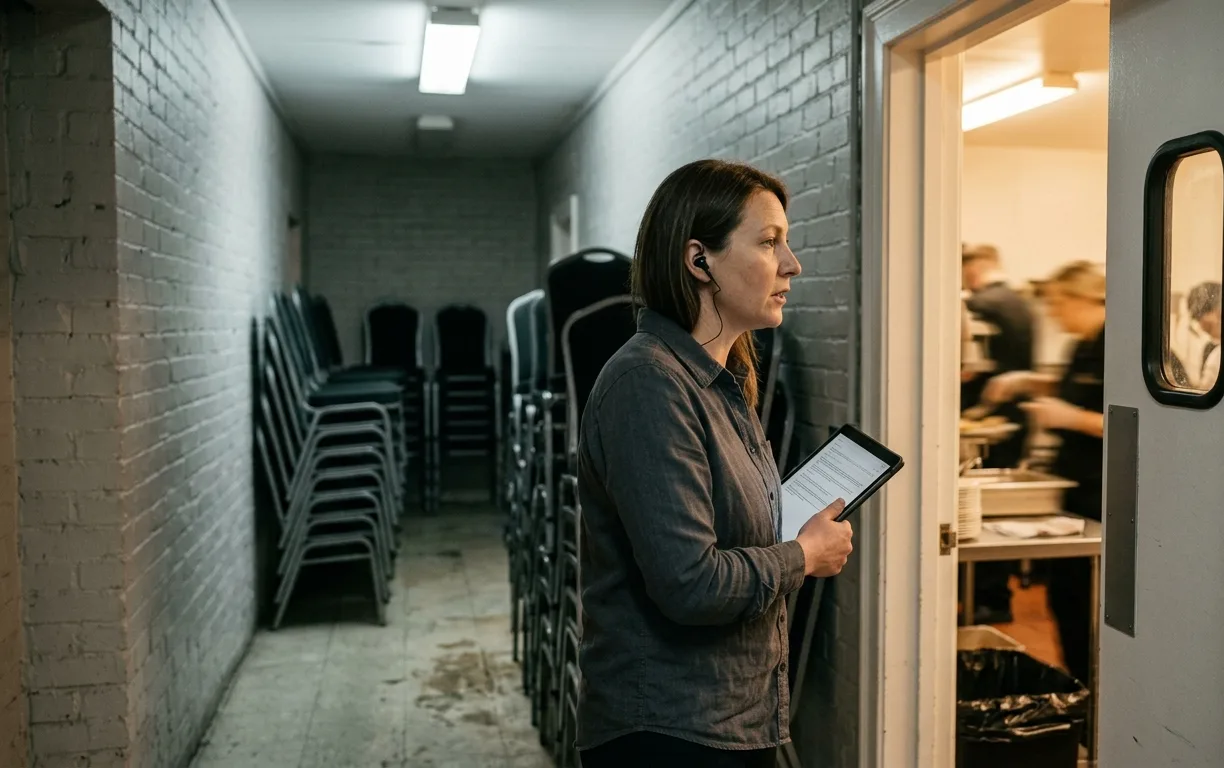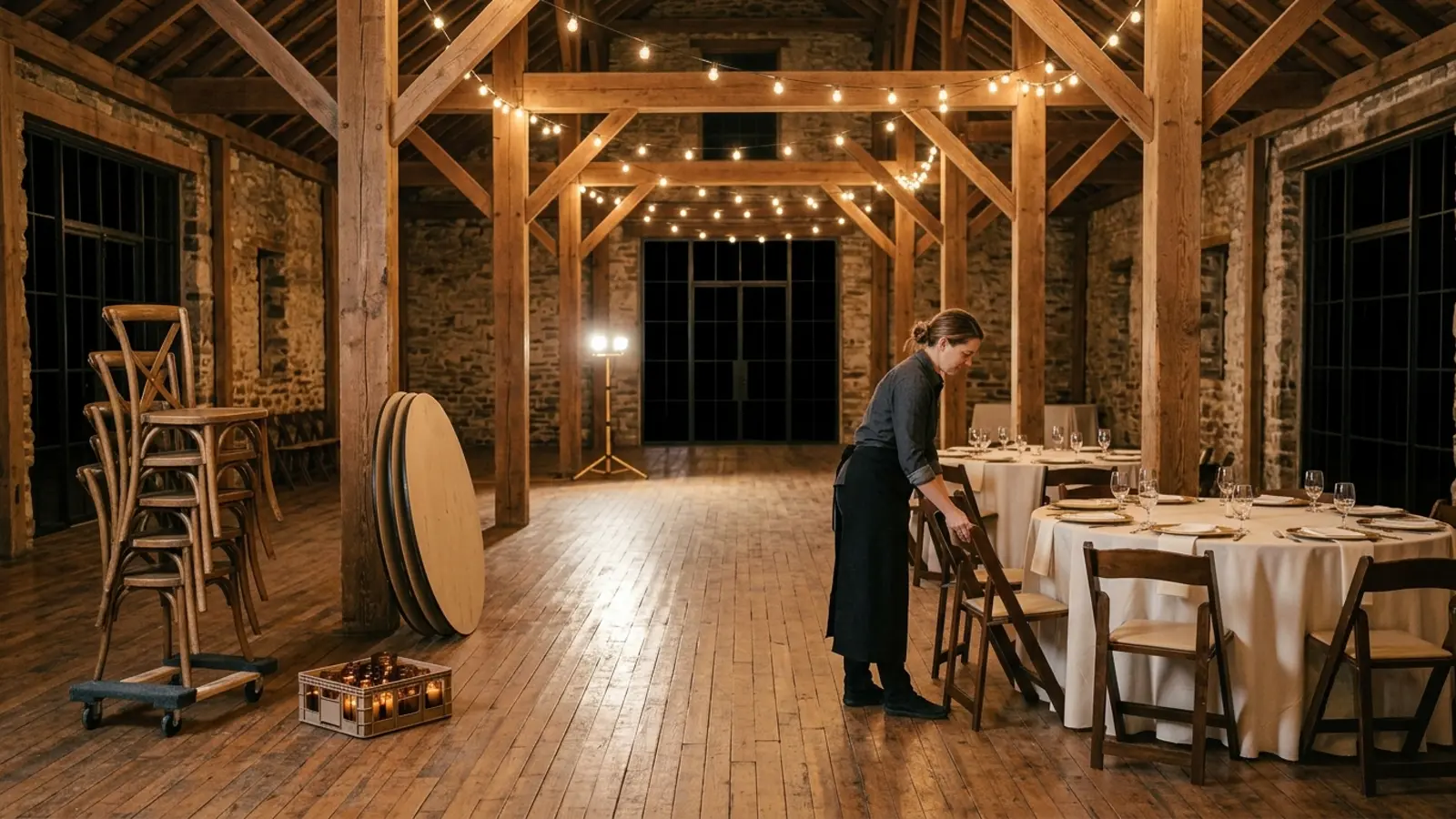
It's 11:40 on a Sunday morning. Saturday's band is still pulling cases out through the same door Sunday's florist wants to bring buckets in through. Someone has to decide who goes first, and that someone is you, standing in a doorway holding a phone with four unread texts on it.
Wedding venue turnaround time is the least glamorous number in your business and the one that quietly decides how many weddings you can hold without your team quitting. It isn't about cleaning faster. It's about knowing exactly what has to be true before the next couple's vendors arrive, and having a way to verify it that doesn't depend on you personally walking the room.
Most venues never write that standard down. They run turnarounds on memory and adrenaline, which works right up until the weekend it doesn't — and the weekend it doesn't is always in August.
What turnaround time actually measures
Ask three people at the same venue how long a turnaround takes and you'll get three answers, because they're measuring three different things.
The banquet lead is thinking about the floor: chairs, tables, linens, back to a neutral state. The coordinator is thinking about readiness: can the next event's timeline start on schedule. The owner is thinking about cost: how many labor hours sit between two revenue events.
Those are all real, and they're not the same clock. A useful turnaround standard measures the one that actually blocks the next wedding — the gap between "last vendor of event A is off property" and "first vendor of event B can begin load-in." Everything else is a subset of that window.
Write it as a single number your team can repeat. Ninety minutes. Three hours. Overnight. The number matters less than the fact that everyone uses the same one.
The four phases of a clean turnaround
Every turnaround, at every venue, is the same four phases in the same order. Naming them is most of the work, because named phases can be assigned, timed, and handed off.
1. Close-out. Event A ends. Vendor load-out, client property collected, trash pulled, damage noted while the evidence is still in the room. This phase fails when it happens in the dark with a skeleton crew who just worked eleven hours.
2. Reset. The room goes back to neutral, not to the next event's layout. This distinction saves real time — a defined neutral state is something a closing crew can execute half-asleep, while "set it for tomorrow" requires them to know tomorrow's floor plan.
3. Stage. Now you build event B's layout from neutral. Different crew, usually a different day, working from a diagram rather than from memory.
4. Verify. Someone with authority walks the room against a list and signs off. This is the phase venues skip, and skipping it is why problems surface at 3pm on Saturday instead of 9am.
The reason to separate Reset from Stage is that they have different failure modes and different labor costs. Collapsing them into "flip the room" is how a two-person closing crew ends up doing a six-person job at midnight.
The five places back-to-back weekends break
The unlogged damage
A chair leg cracks during Saturday's reception. Nobody logs it. It gets stacked with the good chairs, comes out for Sunday, and now it's Sunday's problem — except now you can't tell which couple's deposit it came out of. Damage found during Close-out is attributable. Damage found during Stage is a write-off.
The vendor overlap nobody scheduled
Load-out and load-in through the same door, on the same dock, in the same hour. This is almost never a real conflict — it's a scheduling one. Event A's vendors were given an end time by the coordinator, Event B's vendors were given an arrival time by the couple, and no single system ever compared the two.
The linen and rental gap
Rentals for Saturday go back Monday. Rentals for Sunday arrive Saturday. There is a window where both are on property and neither has a home, and if your inventory lives in someone's head, that window is where counts go wrong and you get billed for items you actually returned.
The staffing cliff
The crew who closed Saturday at 1am cannot open Sunday at 8am. Everyone knows this. It still happens, because turnaround staffing is planned per-event rather than per-weekend, and nobody is looking at the whole 48 hours as one shift-planning problem.
The undocumented handoff
The Saturday coordinator knows the ceremony had to move indoors, that the cake table got relocated, and that the DJ blew a breaker on the north wall. The Sunday coordinator knows none of it. Everything learned on Saturday is lost by Sunday unless something outside a person's memory captured it.
Building a standard you can actually staff
Start from the constraint, not the ideal. Take your tightest realistic weekend — Friday evening, Saturday full-day, Sunday brunch — and work backwards.
Set one number per phase. Close-out 60 minutes. Reset 90. Stage 3 hours. Verify 20. Now you have a 5-hour 50-minute turnaround, and you can see immediately whether the gap you've been selling couples is real.
Assign phases to roles, not to people. "Closing lead owns Close-out and Reset" survives turnover. "Marcus does it" doesn't.
Put the verify step on someone who wasn't in the room. Fresh eyes find the crooked table. The person who set it will not.
Enforce buffers in the booking process, not the operations process. If your standard says six hours and someone books a Sunday ceremony four hours after a Saturday send-off, the failure already happened — it happened at contract signing. This is where a booking calendar with real conflict detection earns its keep: the turnaround rule lives in the system that takes the booking, so the impossible weekend never gets sold in the first place.
Log damage during Close-out, always. Ten minutes with a phone camera while the room is still lit is worth more than an hour of reconstruction on Monday.
Where the handoff problem goes away
Most of the five failure points above are the same problem wearing different clothes: information exists in one person's head at 1am and is needed by a different person at 8am.
That's a systems problem, not a discipline problem. When each event carries its own timeline, vendor arrival windows, layout, and running notes in one place, the Sunday coordinator opens the same record the Saturday coordinator was writing in. Day-of coordination tooling exists precisely so the breaker that blew on the north wall is a note attached to the venue, not a story someone forgot to tell.
The same goes for the weekend as a staffing unit rather than two separate events. Schedule Friday through Sunday on one grid and the problem becomes visible before it becomes a Sunday morning: the same names in the late block and the next early block, with the hours between them written down. That is what stops the closing crew from being scheduled to open.
None of this replaces the standard. Software can't tell you what your turnaround time should be. It can only make sure that once you've decided, the number shows up everywhere the decision matters — in the calendar, on the schedule, in the vendor's arrival email — instead of living in a document nobody opens.
Common questions about venue turnaround time
How long should a wedding venue turnaround take? There's no universal number, because it depends on room size, crew size, and how different the two layouts are. What matters is that you have a number and that it's the same one used by operations, sales, and the booking calendar. A useful starting point is to time your next four turnarounds honestly — including the parts that happened the following morning — and set your standard slightly above the average rather than at your best-ever result. A standard you hit 90% of the time is a standard. One you hit occasionally is a target, and targets don't protect weekends.
Should turnaround happen overnight or the next morning? Split it. Close-out has to happen the night of — damage evidence and vendor accountability both evaporate by morning. Reset can go either way. Stage is almost always better in daylight with fresh crew. The venues that try to complete all four phases at 1am are the ones paying overtime to produce work they'll redo at 9am.
What's the minimum gap I should allow between two weddings? Whatever your four phases add up to, plus a real buffer. The mistake isn't picking a number that's too small — it's picking a number and then not enforcing it in the place where bookings actually get made. If sales can sell a four-hour gap while ops needs six, the number is decorative.
Who should sign off on the Verify phase? Someone who wasn't in the room during Reset or Stage. This is the whole point. The person who set the tables cannot see the crooked one. If your team is too small for that, trade with the opposite shift — the closing lead verifies the morning setup and vice versa.
Do I need software to run turnarounds well? No. You need a written standard, and a clipboard beats no system every time. Software matters at the point where the standard has to be enforced somewhere you aren't standing — in the booking calendar that rejects an impossible gap, in the schedule that flags a rest violation, in the event record that carries Saturday's notes to Sunday's coordinator.
Write it down before September
August is the worst month to build a system and the best month to see exactly which parts of yours are missing. You are, right now, running the weekends that expose every gap. Take notes.
Then close the loop before fall season: one page, four phases, a time per phase, a name per phase, and a verify step with a signature on it.
We've built that page so you don't have to. The Back-to-Back Turnaround Checklist covers all four phases, with the damage-log and vendor-overlap steps built in, a fill-in box for your own neutral state, and a weekend staffing grid that treats Friday through Sunday as one shift-planning problem rather than three events.
It's free, it's a Google Doc you copy straight to your own Drive, and it's built to be printed and filled in by hand — because the crew who need it at midnight are not going to open a spreadsheet.