The Venue Tour That Books Itself: A Conversion Playbook
Most venues spend their marketing budget getting couples through the door, then improvise once they're inside. Here's the route, the one question that changes a tour, and the follow-up sequence that stops good tours going cold.
A couple toured on a Tuesday afternoon in April. They loved it. They said so twice, out loud, standing in the middle of your reception space. They took photos. They asked about parking.
Then nothing. No reply to your email. No reply to the second one. In June you saw the venue they picked, forty minutes away, more expensive than you.
You will recognize that couple, and you probably still don't know what happened. Here's the uncomfortable likelihood: nothing happened. The tour was fine. That was the problem.
Most wedding venue marketing stops at the front door
Look at where the money goes. Photography for the website. The listing sites. The ads. Maybe a videographer. All of it aimed at one outcome: getting a couple to book a tour.
That spend is not wrong, but it's lopsided. Wedding venue marketing is usually excellent right up to the moment a couple arrives on site, and then it stops being marketing at all and becomes whoever happens to be free that afternoon, walking whichever way the doors open, saying whatever comes to mind.
The tour is the highest-leverage forty minutes in your entire sales process. It is the only point where a couple experiences the actual product. And in most venues it is the least designed part of the funnel.
Designing it costs nothing. Here's what that looks like.
Walk the day, not the building
The default tour is an architecture tour: square footage, capacity, which wall the bar goes against, where the power drops are. All accurate. All forgettable.
A couple standing in an empty room is being asked to do imaginative work — to picture a day they haven't planned yet, in a space they've never seen used. Most people are bad at that, and the ones who are good at it are picturing someone else's wedding from Instagram.
So don't make them imagine. Walk the venue in the order the wedding day happens:
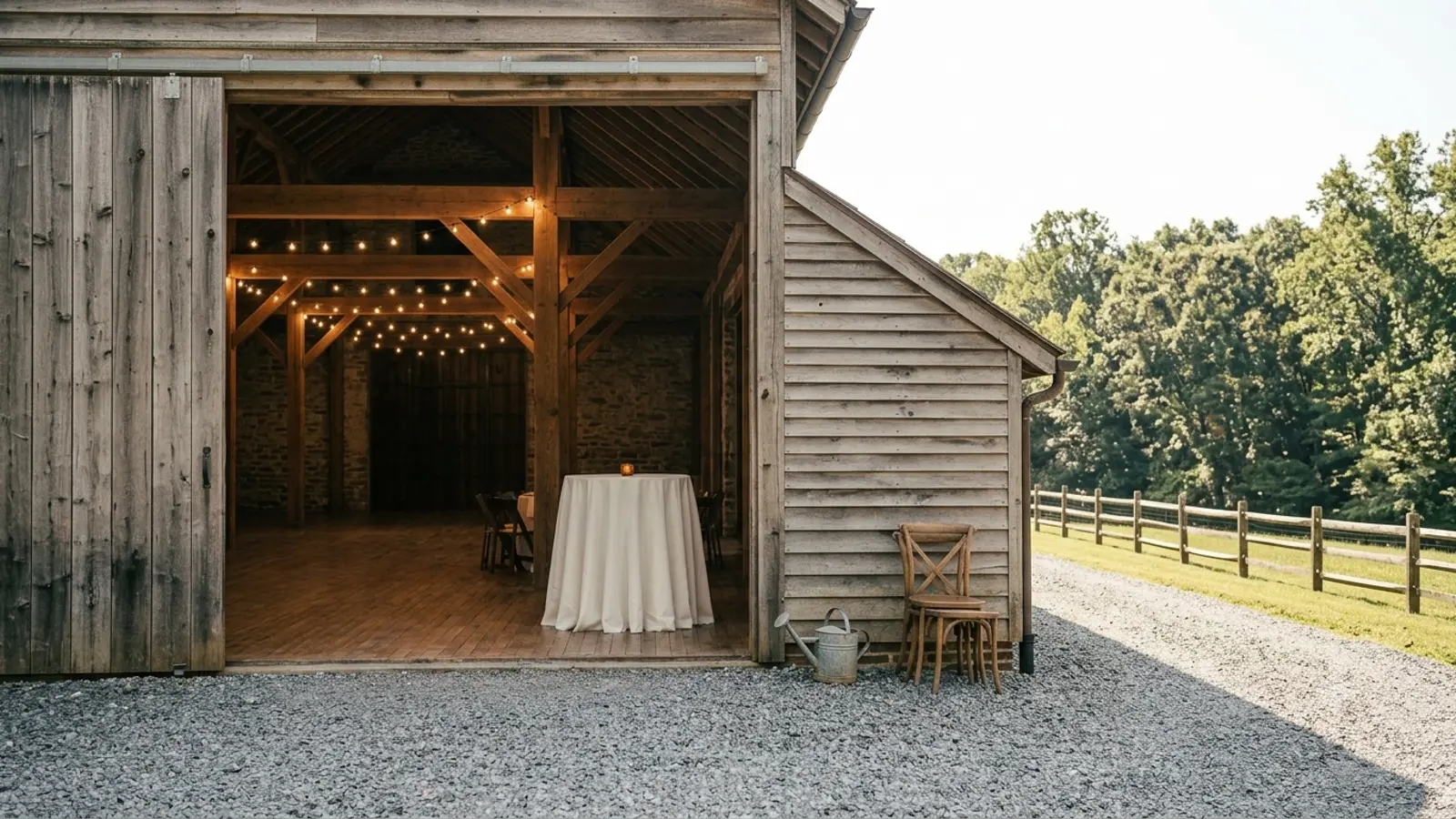
- Arrival — where their guests will park and what they'll see first
- Getting ready — where the morning happens, and what the light does at 10am
- Ceremony — stand where they'd stand, point out where their people would sit
- The gap — where guests go between ceremony and dinner
- Dinner — the room, with one table actually set
- Late night — dancing, the bar, and how the night ends
- Sit down — end seated, not standing in a doorway
Two of those deserve more attention than they usually get.
The gap. Almost no venue tours it. Almost every couple worries about it — that dead ninety minutes where a hundred people mill around while photos happen. If you show them exactly where those guests go and what's in their hands, you've answered a question they were too polite to ask.
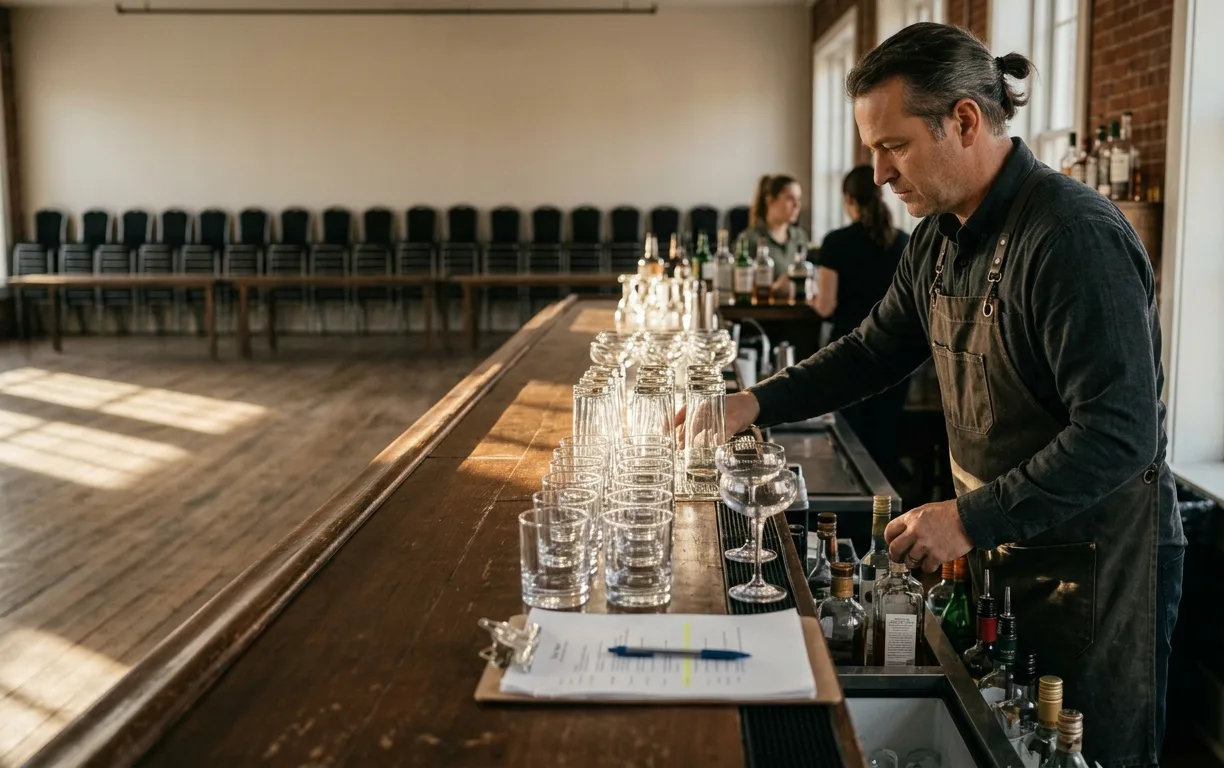
One set table. Not the whole room. One table, dressed properly, with a linen and a place setting, the way most of your couples actually do it. It takes fifteen minutes before the tour and it does more work than any other fifteen minutes you will spend that week. An empty room asks a couple to imagine; a set table shows them.
Minute four
Four minutes in, they've stopped being nervous. You haven't started selling yet. This is the moment to ask one question and then stop talking:
"What would have to be true for this to be the easy choice?"
Then be quiet. Genuinely quiet — long enough to be slightly uncomfortable.
Whatever they say next is the actual sale, and it's almost never the thing you were about to talk about. In practice the answer is one of five, and each one has a different correct response on the spot:
"If we could afford it." Price is a shape problem, not a number problem. Show them a lower-demand date or a smaller package. Don't discount the Saturday — you'll sell it to someone else, and you've just taught this couple that your prices are a starting position.
"If my mum liked it." There's a decision-maker who isn't in the room. Book the second visit before they leave today, with a name and a date on it.
"If it rains, then what?" They're picturing a failure and want to hear you've already solved it. Don't describe the wet-weather space. Walk them into it and stand there.
"If we knew it was ours." They're ready and frightened of losing the date. Offer the hold. This is the easiest booking of your month and the one most often left on the table because nobody asked.
"We're seeing three more." You're being compared and haven't been made memorable yet. Ask what they liked at the others — they'll tell you, and it's free competitor research. Then be honest about where you're not the fit. Nothing builds trust faster than a venue that rules itself out of something.
Write their answer down in front of them. It signals you're going to act on it, and it hands you the first line of your follow-up email.
Never end a tour without a date in your calendar
Not a promise to email. A date.
The tours that evaporate are almost always the ones that ended with "let me know" — which quietly hands the decision to whichever venue follows up best. Ask for something small and specific instead, matched to where they actually are:
- Clearly ready → the date. "Shall I hold the 12th while you talk it over?"
- Warm but hesitant → a second visit, with whoever's missing, on a named day
- Comparing venues → permission to send the proposal today and to call on a named day
- Early in planning → their date range, and permission to tell them when it starts filling
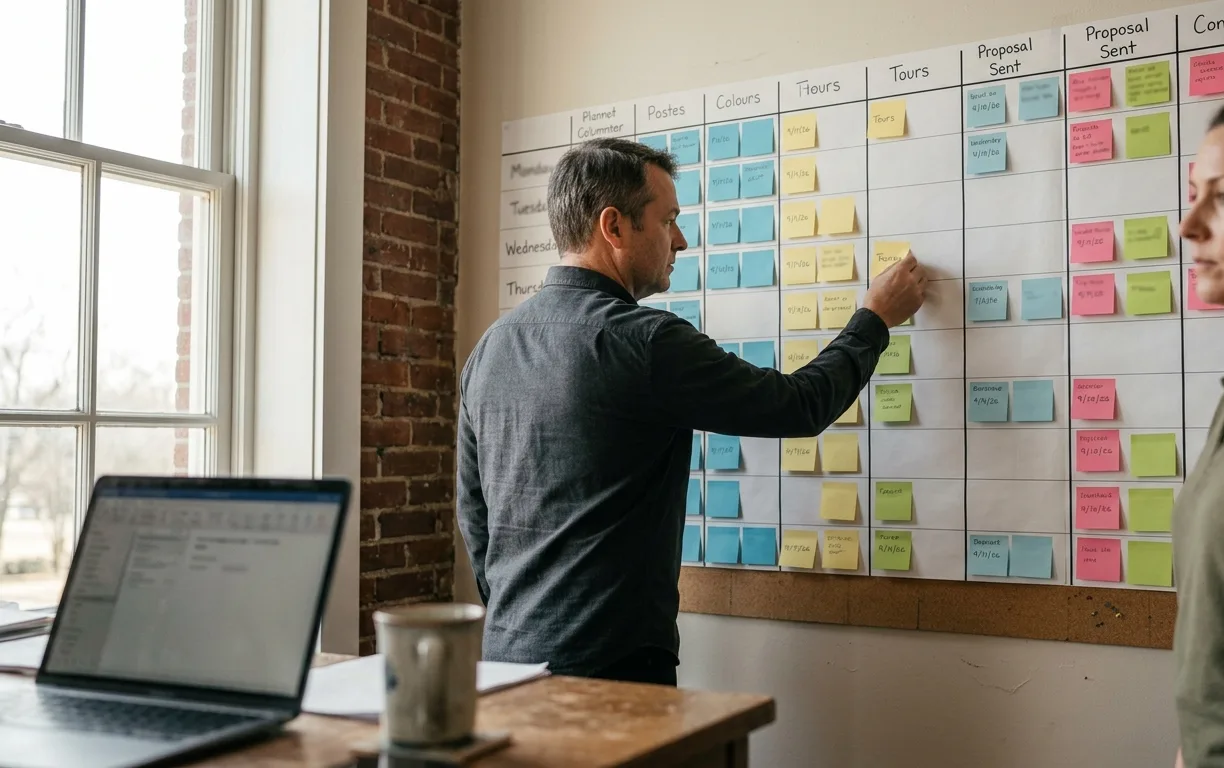
That's the difference between a pipeline and a list of names. A pipeline has next steps with dates attached; a list of names has good intentions. Keeping the first from decaying into the second is most of what a venue CRM is actually for — every couple on a board, every next step with a date, nothing depending on you remembering a Tuesday in April.
The follow-up sequence, and why the last email works
Five emails. The first goes out the same day, while they're still in the car.
| When | Its one job |
|---|---|
| Same day | Answer the minute-four thing in writing. Attach the proposal. |
| Day 2 | One detail they didn't see — a reason to be in the inbox again |
| Day 5 | Proof. One real wedding in their season. |
| Day 9 | A real deadline, honestly stated. Scarcity you can defend. |
| Day 14 | "Closing the file — unless?" |
The last one feels like giving up, and it reliably outperforms the four before it. People answer a closing door. A message that gives someone permission to say no gets a response from couples who've been avoiding you for a fortnight — and roughly half the time the response is "no, wait."
One rule for the whole sequence: every email should be sendable without you having written anything new. If each follow-up requires fresh composition, it won't happen in October. Write the five once, fill in the brackets, and the sequence survives your busiest month.
The two numbers, and why you must never average them
Most venues track one figure: "conversion." It's the least useful number in the business, because it hides which half is broken.
Split it:
- Inquiry → tour. How many people who contacted you actually came. This measures your reply speed and your first email. Almost nothing else.
- Tour → booking. How many people who came, booked. This measures the tour itself.
They fail for completely different reasons and they have completely different fixes. A venue with strong tour-to-booking and weak inquiry-to-tour doesn't have a sales problem — it has a response-time problem, and no amount of tour rehearsal will touch it. Average the two together and you'll spend the winter fixing the wrong one.
If you want a starting reference point, our Tour-to-Booking Benchmark compares your close rate against the 18% figure it uses as its baseline, and calculates what a five-point improvement is worth against your own average booking value. That number is usually larger than people expect, which is the point: tour conversion is the cheapest growth available to a venue, because the traffic is already arriving.
What to do this month
September is the right month for this and October is not. You're touring 2027 shoppers right now, in the weeks when your grounds look their best and there are real events happening for couples to glimpse. Every tour you give in the next six weeks is a rehearsal you're paying for anyway.
So: write the route down. Set one table before each tour. Ask the minute-four question and write the answer down. Then, after ten tours, read the answers together.
The one that repeats is not an objection. It's the thing your marketing should have said before those couples ever arrived — and that's a website edit, not a sales problem.
We've written the whole thing up so you don't have to. The Venue Tour Script & Follow-Up Sequence has the seven-stop route with space for your own wording at each stop, the five minute-four answers and what to do about each one, all five follow-up emails, and a tour log for the two numbers above.
It's free, it's a Google Doc you copy straight to your own Drive, and it's built to be edited into your venue's voice rather than read once and forgotten.
Common questions
How long should a venue tour be? Long enough to walk the day in order and still sit down at the end — for most venues that's 40 to 60 minutes. Shorter and you're skipping the gap or the sit-down; much longer and you're filling time, which reads as uncertainty rather than generosity.
Should I give pricing on the tour? Yes, and early. Withholding price to "get them invested" mostly produces couples who feel ambushed at the sit-down. Say the number out loud, then spend the tour showing what it buys. The couples for whom it's genuinely wrong were never going to book, and you've saved everyone a fortnight.
What if two people give tours and they do it differently? That's the strongest argument for writing the route down. A consistent route isn't about scripting personality out of it — it's what makes it possible to notice that couples go quiet in the same room every time. You cannot spot a pattern in a process that changes every Tuesday.
Do I need software to convert tours better? No. You need a written route, a question, and five emails you don't have to rewrite. Software matters at the point where the next step has to survive a Saturday you spent on the floor — where the follow-up goes out whether or not you remembered it, and where the couple who toured in April is still visibly waiting on something in June.