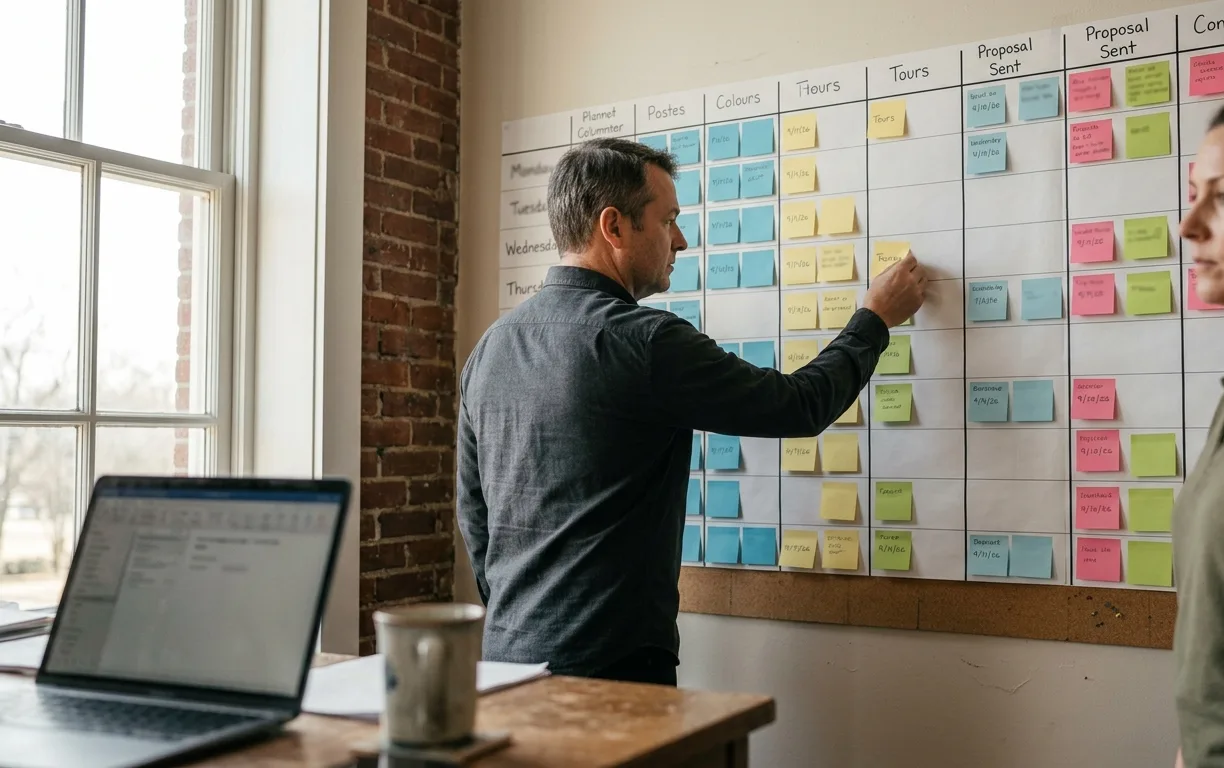
July is inquiry season. Couples who got engaged over the holidays are deep in planning, summer weddings have friends dreaming about their own, and your inbox fills up. It feels like good news, and it is, right up until you realize how many of those inquiries you're quietly losing.
An inbox is not a sales system. Leads get buried, follow-ups get forgotten, and the couple who emailed on Tuesday hears back Thursday, by which point they've booked someone who answered that afternoon. The venues that convert well during a busy season aren't working harder; they're running a real pipeline. Wedding venue lead management is the discipline of moving every inquiry deliberately from first contact to signed contract, and here's how to build one.
Why a pipeline beats an inbox
An inbox is a pile. A pipeline is a process. The difference is visibility and follow-through.
With a pipeline, you can see every lead and exactly where each one sits: new inquiry, toured, proposal sent, following up, booked. Nothing hides. You know who needs a nudge today and who's gone quiet. And because most bookings take several touches, a pipeline makes sure the follow-ups actually happen instead of depending on someone remembering. In peak season, when volume is highest and attention is thinnest, that structure is the whole difference between converting your leads and leaking them.
The stages of a venue lead pipeline
1. Capture every inquiry, from everywhere
The first leak is the one you never see: inquiries that never make it into your system at all. Contact forms, emails, phone calls, marketplace messages, DMs. If they land in five different places, some will slip. Get every inquiry into one place, automatically where possible, so nothing depends on someone checking a channel they forgot about.
2. Qualify fast
Not every lead is equal. A quick qualification (is the date available, is your venue in their budget range, are they a fit) tells you where to spend your energy. This is where lead scoring earns its keep: it surfaces the couples most likely to book so your best, fastest effort goes to your best opportunities, not to a tire-kicker who happened to email first.
3. Tour or consultation
The tour is where love happens, so make booking one effortless. The faster and simpler it is to get a serious couple onto your property or into a call, the more of them you convert. Every bit of friction between "I'm interested" and "I'm booked for a tour" costs you.
4. Deliver the proposal quickly
Right after the tour, while excitement is warm, the proposal goes out. Speed matters as much here as anywhere in the pipeline. A same-day, clear, well-priced proposal keeps momentum; a slow one lets a competitor catch up. (This is a whole discipline of its own, but the pipeline point is simple: don't let a hot lead cool while a proposal sits in your to-do list.)
5. Follow up on purpose
Here's the stage that separates good venues from great ones. Most bookings don't happen on the first touch. Couples get busy, compare options, and go quiet, and a silent couple is not a no; they're a not-yet. A planned follow-up sequence (a check-in, a nudge, a gentle "still holding your date?") recovers bookings that a busy inbox would simply drop. More revenue hides in disciplined follow-up than in almost any new marketing.
6. Close and confirm
The final stage should be frictionless: a clear path from "yes" to a signed contract and a collected deposit. The easier you make this, the fewer couples you lose at the one-yard line to hesitation or hassle.
Watch the numbers that actually move bookings
You can't improve what you don't measure. Three metrics tell you most of what you need:
- Response time. How fast do you reply to a new inquiry? This is often the single biggest lever on conversion, and it's entirely in your control.
- Conversion rate. What share of inquiries become bookings? Track it and you'll know whether a change actually helped.
- Stage drop-off. Where do leads stall? If lots of couples tour but few get proposals, or get proposals but never book, the leak has an address, and you can fix it.
Run it in a CRM built for venues
A pipeline you manage in your head or a spreadsheet works until volume spikes, which is exactly when you need it most. A venue CRM keeps the whole thing running when you're too busy to babysit it.
That's the role CeremonySync's CRM plays. Inquiries land in a pipeline with lead scoring, so you see every lead and where it stands. Automatic follow-ups keep couples warm without you remembering each one. Proposals generate fast and tie back to the lead, and the path from inquiry to signed contract and deposit lives in one place. During your busiest month, that's the difference between converting the leads you worked so hard to get and watching them slip out of a crowded inbox.
Frequently asked questions
What is a wedding venue lead pipeline? It's a structured process for moving every inquiry from first contact to signed contract, with clear stages: capture, qualification, tour, proposal, follow-up, and close. Unlike an inbox, a pipeline shows you where every lead sits and makes sure follow-ups happen, which is what raises conversion during a busy season.
How can venues convert more leads during peak season? Respond faster, qualify leads so your best effort goes to your best opportunities, get serious couples on a tour quickly, send proposals same-day, and follow up on a plan rather than by memory. The biggest gains usually come from response time and disciplined follow-up, not from generating more leads.
Why isn't email enough to manage venue leads? An inbox has no structure, so leads get buried, their status is invisible, and follow-ups depend on someone remembering. A pipeline (ideally in a venue CRM) gives every lead a place and a next step, which is what keeps inquiries from slipping through the cracks when volume is high.
The bottom line
The inquiries you're getting this month are the bookings for next season, but only if you catch them. Capture every lead, qualify quickly, tour and propose fast, follow up on purpose, and make closing easy. Manage that as a pipeline instead of a pile, and you'll convert more of the demand you already have.
Optimize your lead pipeline with CeremonySync CRM, and stop losing peak-season inquiries to a crowded inbox.